DBot Martingale Settings Guide
In the rapidly evolving landscape of automated financial trading, the year 2026 has seen a significant surge in the accessibility of algorithmic tools. Among these, Deriv’s DBot remains a cornerstone for retail traders looking to automate their strategies without needing deep coding knowledge. However, with great power comes great responsibility—specifically the responsibility of risk management. This DBot Martingale settings guide is designed to provide you with a high-level, authoritative framework for configuring one of the most popular, yet most misunderstood, strategies in the trading world.
The Martingale strategy is a relic of 18th-century French probability theory, originally applied to gambling. In the context of 2026 trading, it has been refined through machine learning filters and sophisticated bot logic. At its core, the strategy involves doubling your stake after every loss, with the premise that a single win will recover all previous losses plus a profit equal to the original stake. On a platform like DBot, the precision of your settings determines the thin line between a growing balance and a blown account.
Understanding the Martingale Logic in DBot
Before diving into the specific variables, it is crucial to understand how DBot processes the Martingale sequence. Unlike manual trading, where emotions might cause you to hesitate, a bot will execute the multiplier logic with cold, mechanical precision. This is both an advantage and a danger.
In DBot, the Martingale logic is typically housed within the ‘Analysis’ and ‘After Purchase’ blocks. The bot tracks the result of the last trade; if the result is a ‘Loss,’ it applies a mathematical multiplier to the ‘Initial Stake.’ If the result is a ‘Win,’ the bot resets the stake to the original base amount. While this sounds simple, the mathematical variance in modern markets requires more than just a 2x multiplier.
Why Martingale Still Matters in 2026
Many financial analysts dismiss Martingale as a ‘gambler’s fallacy.’ However, in the high-frequency environment of Synthetic Indices (like those offered on Deriv), Martingale serves as a powerful recovery mechanism when paired with high-probability entry signals. The key in 2026 is no longer ‘pure’ Martingale, but ‘Smart Martingale’—using settings that account for volatility and consecutive loss limits.
Essential DBot Martingale Settings
Configuring your bot requires a balance between aggressive recovery and capital preservation. Below are the primary settings you must calibrate within your DBot XML or block interface.

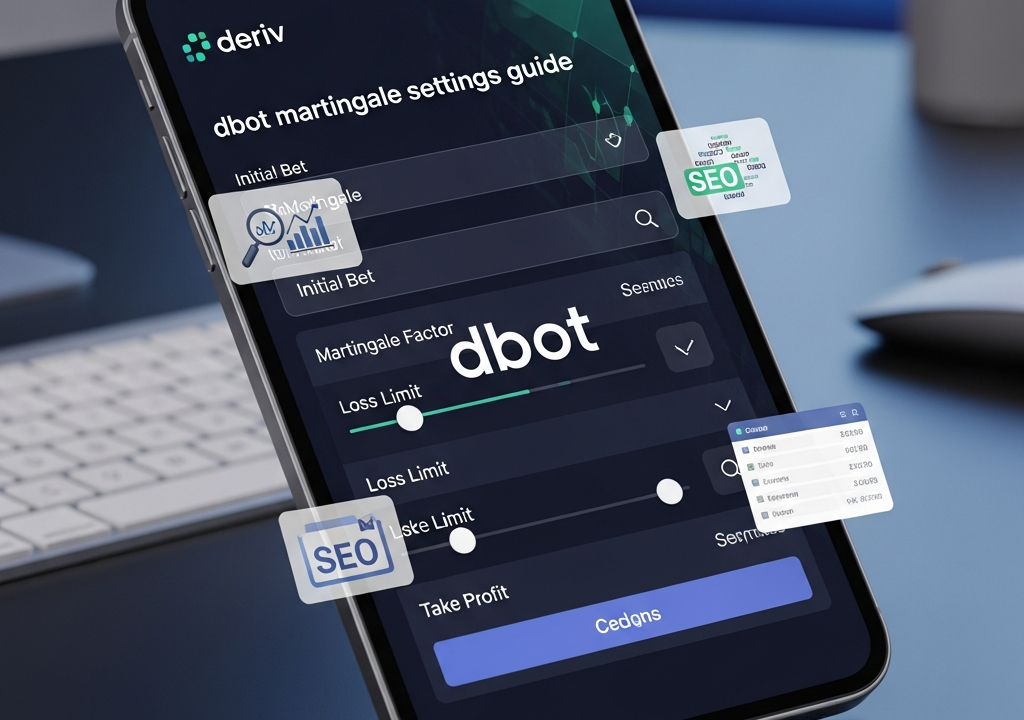
1. The Initial Stake
The Initial Stake is the most important setting. It should never be determined by greed, but by your total account equity. A common rule of thumb in 2026 is that your initial stake should represent no more than 0.5% to 1% of your total balance. If you are starting with $1,000, your initial stake should be $1.00 or $5.00. This provides a ‘runway’ for the multiplier to work during a losing streak.
2. The Multiplier (The Martingale Factor)
Most traders instinctively set the multiplier to 2.0. However, because of the ‘payout’ structure on platforms like Deriv (where a win might pay 95% instead of 100%), a 2.0 multiplier may not actually cover your losses and provide a profit. For digital options (Over/Under, Rise/Fall), a multiplier of 2.1 or 2.15 is often more effective at ensuring the recovery actually results in a net gain.
3. Maximum Martingale Steps (The Circuit Breaker)
One of the most critical parts of this DBot Martingale settings guide is the ‘Max Steps’ configuration. You must decide at what point the bot should stop doubling and accept the loss. Without a circuit breaker, a string of 10 or 12 losses (which can and will happen) will liquidate your entire account. Professional configurations usually cap Martingale steps at 5 to 7 iterations.
4. Take Profit and Stop Loss
Your ‘Take Profit’ should be realistic. Aiming for 5% to 10% of your balance per session is sustainable. Your ‘Stop Loss’ for the entire bot session should be the cumulative value of your Max Martingale Steps. If your sequence of 6 steps fails, the bot should shut down to prevent further damage.
Step-by-Step Configuration Guide
If you are looking to set up your first Martingale bot on Deriv, follow these steps to ensure the logic is sound.
- Define Variables: Open the ‘Variables’ tab and create entries for
initial_stake,amount,multiplier, andmax_loss. - Initialize: In Block 1 (Run Once), set
amounttoinitial_stake. - Purchase Logic: In Block 2, use a ‘Purchase’ block. We recommend using a trend-following indicator like a Simple Moving Average (SMA) or the Relative Strength Index (RSI) to ensure you aren’t just entering trades randomly.
- Post-Trade Logic: This is where the Martingale happens. In Block 4 (After Purchase), use an ‘If/Else’ statement.
- If
Contract Detail: Profit> 0, setamountback toinitial_stake. - Else (if the trade was a loss), set
amounttoamount * multiplier.
- If
Advanced Strategies: Beyond Basic Martingale
As we move through 2026, simple Martingale is rarely enough to beat the market consistently. To truly optimize your DBot Martingale settings guide application, consider these advanced modifications:
The Virtual Loss Strategy
A sophisticated way to use Martingale is to implement ‘Virtual Losses.’ The bot monitors the market and simulates trades. It only begins placing real money trades after it has seen 2 or 3 ‘virtual’ losses in a row. This significantly reduces the probability of hitting your Max Martingale Steps, as you are entering the market during a predicted reversal of a losing streak.
Tiered Multipliers
Instead of a flat 2.1x multiplier, some traders use a tiered approach. For the first three losses, they use 2.0x. For the fourth and fifth, they increase it to 2.5x. This can speed up recovery but requires a much higher risk tolerance and a larger capital base.
Volatility-Adjusted Stakes
In 2026, the Deriv API allows bots to read the ‘Current Volatility Index.’ You can program your DBot to reduce the initial stake when volatility is high (indicating unpredictable market swings) and increase it during periods of stable trends.
Risk Management: The “Anti-Bust” Philosophy
The biggest mistake traders make with Martingale is treating it as a ‘set and forget’ system. To stay profitable, you must treat your bot like a business employee. Even with the perfect settings, market anomalies occur.
The 24-Hour Rule: Never run a Martingale bot for 24 hours straight. Markets change phases from trending to ranging. A Martingale bot designed for ranging markets will be destroyed by a strong trend. Limit your bot sessions to 1–2 hours during peak liquidity times.
Withdrawal Frequency: When using Martingale, your account balance is your shield. However, once you have doubled your initial capital, withdraw the original amount. From that point on, you are ‘playing with the house’s money,’ which drastically changes the psychology of your trading.
Common Pitfalls in DBot Configurations
- Ignoring the Payout Percentage: If the payout of the asset you are trading is only 80%, a 2x multiplier will result in a net loss even after a ‘win.’ Always calculate your multiplier based on
(1 / Payout Ratio) + small buffer. - Too Many Steps: It is tempting to allow 10 steps because ‘it’s impossible to lose 10 times in a row.’ In the world of Synthetic Indices, 10 consecutive losses are not only possible but inevitable over a long enough timeline.
- Lack of Trend Filtering: Entering a ‘Rise’ trade during a massive downward spike just because the Martingale sequence says so is a recipe for disaster. Use Block 2 to ensure the market direction aligns with your trade.
Backtesting and Optimization
Before taking your settings to a live account, use the Deriv Demo environment. In 2026, backtesting has become more streamlined. Run your bot through at least 500 trades on Demo. Analyze the ‘Max Drawdown’—this is the furthest your balance dropped during a losing streak. Your live account must be able to handle at least 3x that drawdown to be considered safe.
Keep a log of your settings. If you find that a 2.1 multiplier on the Volatility 100 Index works well during the London session, but fails during the New York session, adjust your schedule accordingly. Data-driven adjustments are the hallmark of a professional bot trader.
Conclusion
Mastering the DBot Martingale settings guide is about respect—respect for the mathematics of probability and respect for the volatility of the markets. By carefully setting your initial stake, choosing a mathematically sound multiplier, and strictly enforcing a maximum step limit, you can transform a high-risk gamble into a structured, automated trading system.
As we navigate the trading environment of 2026, the tools at our disposal are more powerful than ever. However, no bot is a ‘money printer.’ Success with DBot Martingale settings requires constant oversight, regular optimization, and the discipline to walk away when your stop loss is hit. Start small, test rigorously, and let the logic of the bot work within the safeguards you have established.