Introduction to Automated Precision in 2026
As we navigate the financial landscape of 2026, the evolution of retail trading has reached a pivotal point where automation is no longer a luxury but a necessity for consistency. Among the various platforms available, Deriv remains a titan in the industry, particularly known for its versatile Dbot interface. For traders looking to capitalize on market volatility without staring at charts for hours, the Deriv Bot RSI and Stochastic strategy has emerged as one of the most reliable frameworks for both synthetic indices and traditional forex pairs.
This strategy leverages two of the most time-tested oscillators in technical analysis: the Relative Strength Index (RSI) and the Stochastic Oscillator. Individually, they are powerful; together, they provide a filtering mechanism that reduces false signals and identifies high-probability entry points. In this comprehensive guide, we will break down the mathematical logic, the configuration on the Dbot platform, and the risk management protocols required to succeed in the current market environment.
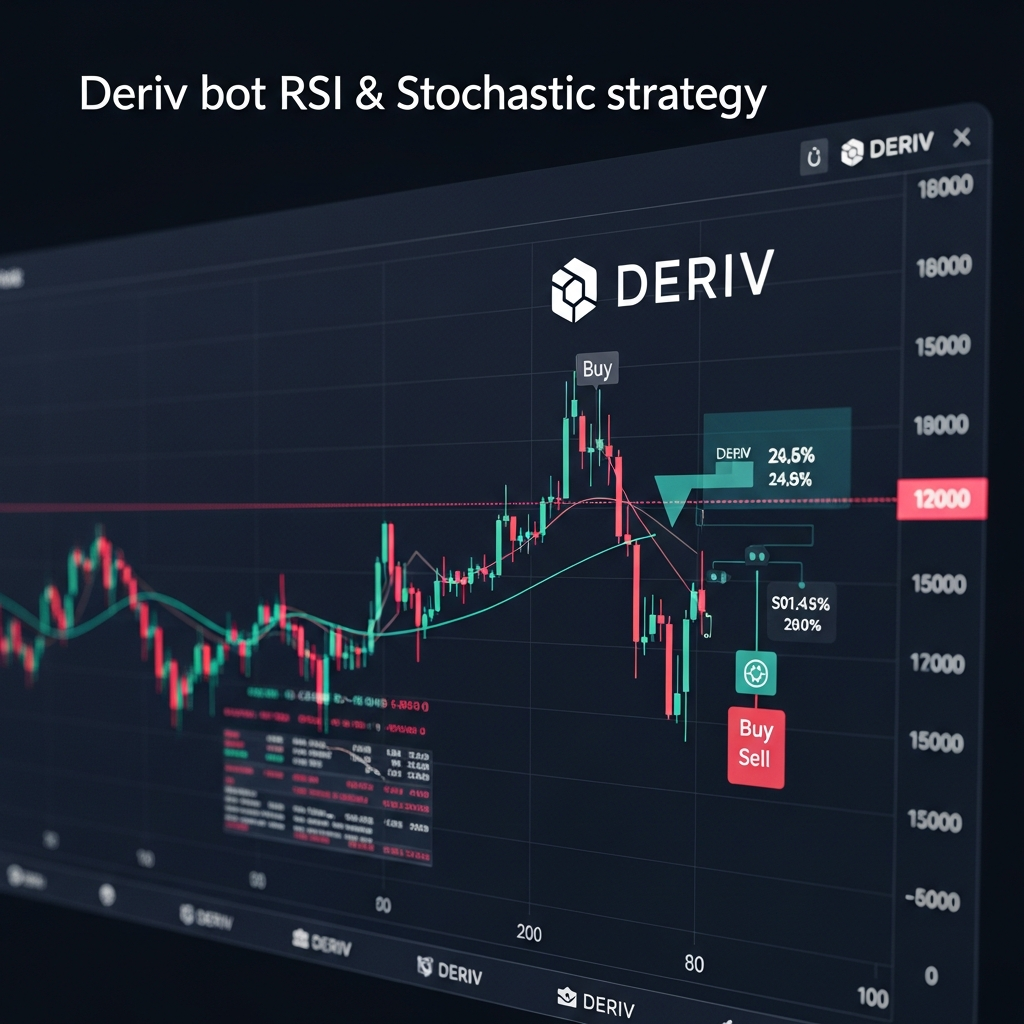
Understanding the Core Indicators
The Relative Strength Index (RSI)
The RSI is a momentum oscillator that measures the speed and change of price movements. Developed by J. Welles Wilder, it fluctuates between 0 and 100. Traditionally, an RSI above 70 indicates an overbought condition, while an RSI below 30 suggests an oversold state. However, in 2026, sophisticated traders often use the 50-level as a trend confirmation tool. When we integrate RSI into a Deriv Bot, we aren’t just looking for extremes; we are looking for the momentum to sustain a reversal.
The Stochastic Oscillator
While the RSI tracks momentum relative to price levels, the Stochastic Oscillator compares a specific closing price of a security to a range of its prices over a certain period of time. It consists of two lines: %K (the main line) and %D (the moving average of %K). The Stochastic is generally more sensitive than the RSI, making it excellent for timing entries. We look for crossovers in the overbought (80) and oversold (20) regions to signal that a price correction is imminent.
Why Combine RSI and Stochastic?
The primary weakness of the RSI is its tendency to stay overbought or oversold during strong trends, leading to premature entries. Conversely, the Stochastic can be “noisy,” giving frequent signals that result in whipsaws. By combining them in a Deriv Bot logic, we create a double-confirmation system. We only execute a trade when both indicators agree that the market is stretched and ready to pivot. This “confluence” is the secret sauce of the Deriv Bot RSI and Stochastic strategy.
Setting Up the Deriv Bot Logic
To implement this strategy, you must access the Dbot canvas on the Deriv platform. The logic follows a “Boolean” structure—the bot checks if Condition A (RSI) AND Condition B (Stochastic) are met simultaneously.
Step 1: Defining the Variables
First, you need to create variables for your indicators. In the block editor, set your RSI period to 14 (standard) or 7 (for higher frequency). For the Stochastic, the standard 14, 3, 3 setting is recommended. You must also define your stake, take profit, and stop loss variables to ensure the bot operates within your risk parameters.
Step 2: The Purchase Logic
For a “Call” (Buy) signal, the logic should be:
- RSI (14) is less than 30.
- Stochastic %K is less than 20 AND Stochastic %K crosses above %D.
For a “Put” (Sell) signal, the logic is reversed:
- RSI (14) is greater than 70.
- Stochastic %K is greater than 80 AND Stochastic %K crosses below %D.

Optimizing for Synthetic Indices
Deriv is famous for its Synthetic Indices like Volatility 100 (1s) or the Crash/Boom indices. These markets are algorithmically generated and operate 24/7. Because these markets do not follow traditional economic news, the Deriv Bot RSI and Stochastic strategy works exceptionally well here. However, due to the high volatility of indices like V75, you might need to widen your overbought/oversold levels to 80/20 for RSI and 90/10 for Stochastic to avoid getting caught in “runaway” trends.
Timeframe Selection
In 2026, the 1-minute (M1) and 5-minute (M5) timeframes are the most popular for bot trading. The M1 timeframe offers more signals but requires tighter risk management. The M5 timeframe provides more stability and allows the Stochastic Oscillator to filter out the “micro-noise” of the market.
Risk Management and the Martingale Trap
Many traders fall into the trap of using a Martingale multiplier with their Deriv Bot. While Martingale can recover losses quickly, it can also wipe out an account during a prolonged trend where the RSI and Stochastic remain pegged at extremes.
A safer alternative for 2026 is the “D’Alembert” system or simply using a flat stake with a positive risk-to-reward ratio (e.g., 1:2). Set your bot to stop trading after a certain number of consecutive losses or once a daily profit target is reached. Remember, the goal of automation is capital preservation, not just capital gains.
Advanced Filtering with Moving Averages
To further refine the Deriv Bot RSI and Stochastic strategy, consider adding a 200-period Exponential Moving Average (EMA) as a trend filter.
- Only Buy: If the price is above the 200 EMA.
- Only Sell: If the price is below the 200 EMA.
This ensures you are trading with the primary trend, significantly increasing the win rate of the RSI and Stochastic crossovers.
Backtesting and Live Performance
Before deploying your bot with real capital, use the Deriv demo account to run at least 500 trades. Analyze the “maximum drawdown” and the “success rate.” In the 2026 version of Dbot, you can export these results to CSV files for deeper analysis. If the bot performs well in various market conditions (ranging vs. trending), you can gradually transition to a live account with a small stake.
Common Pitfalls to Avoid
- Over-optimizing: Don’t try to find the “perfect” settings that fit past data perfectly; they likely won’t work in the future.
- Ignoring Market Regime: Indicators fail during “Black Swan” events. Even though synthetics are simulated, they can exhibit extreme movements.
- Neglecting Updates: Check your bot’s logic periodically to ensure it aligns with any platform updates Deriv may have implemented in 2026.
The Psychology of Bot Trading
Even though the bot is doing the heavy lifting, the human element remains the weakest link. The temptation to interfere when a bot is in a drawdown is high. By using the Deriv Bot RSI and Stochastic strategy, you must trust the mathematics behind the confluence. If your backtesting was rigorous, the law of large numbers will eventually work in your favor.
Conclusion
The Deriv Bot RSI and Stochastic strategy remains a cornerstone of automated trading for a reason: it balances momentum and mean reversion beautifully. By following the logic outlined in this guide—implementing strict RSI and Stochastic crossovers, filtering with the 200 EMA, and maintaining disciplined risk management—you can build a robust trading tool capable of navigating the 2026 markets. Automation is about removing emotion; let the indicators speak, and let the bot execute.
As you refine your DBot, remember that the best strategy is one that you understand deeply. Take the time to tweak the periods, test different indices, and find the settings that align with your personal risk tolerance. Happy trading!