The Invisible Thief in Your Trading Account
In the landscape of 2026 retail trading, where algorithmic execution accounts for nearly 80% of volume in the currency and derivatives markets, the battle is no longer just about who has the best strategy. It is increasingly about who has the fastest connection. For traders running Expert Advisors (EAs), a common frustration arises when backtested results, which look stellar on paper, fail to translate into real-world profits. The culprit is often a combination of two technical phenomena: latency and slippage.
While many traders focus on their EA’s logic or the spread offered by their broker, they frequently overlook the infrastructure bridging the two. This article explores the deep, technical relationship between VPS latency and the actual price you receive on your trades, providing a roadmap for minimizing the ‘invisible thief’ of slippage.
Defining the Core Conflict: Latency vs. Slippage
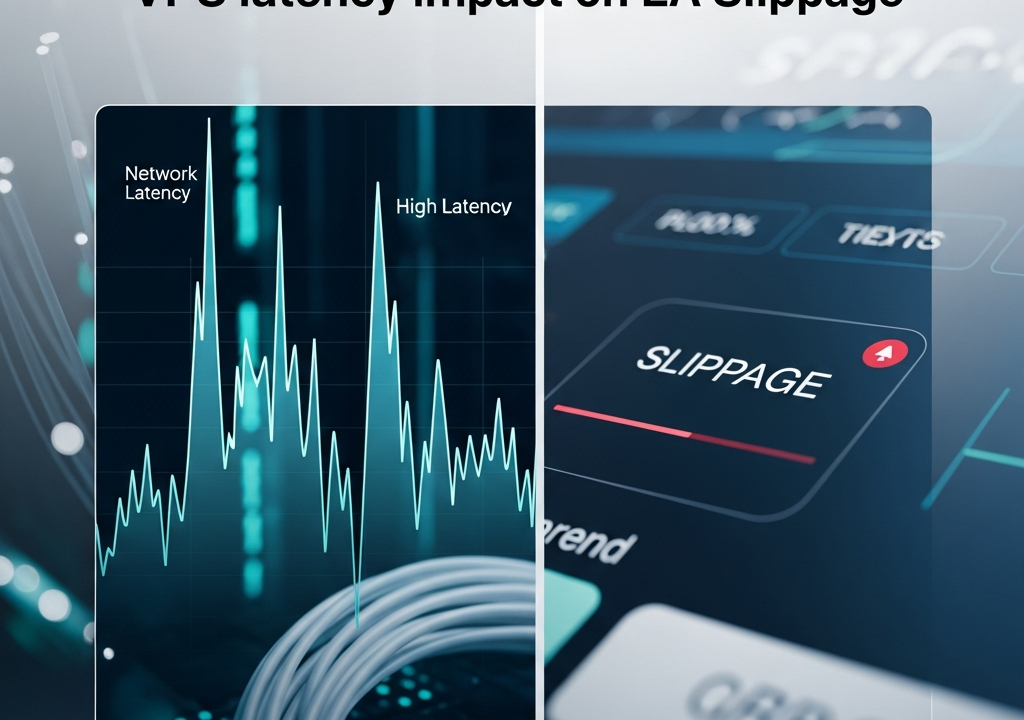
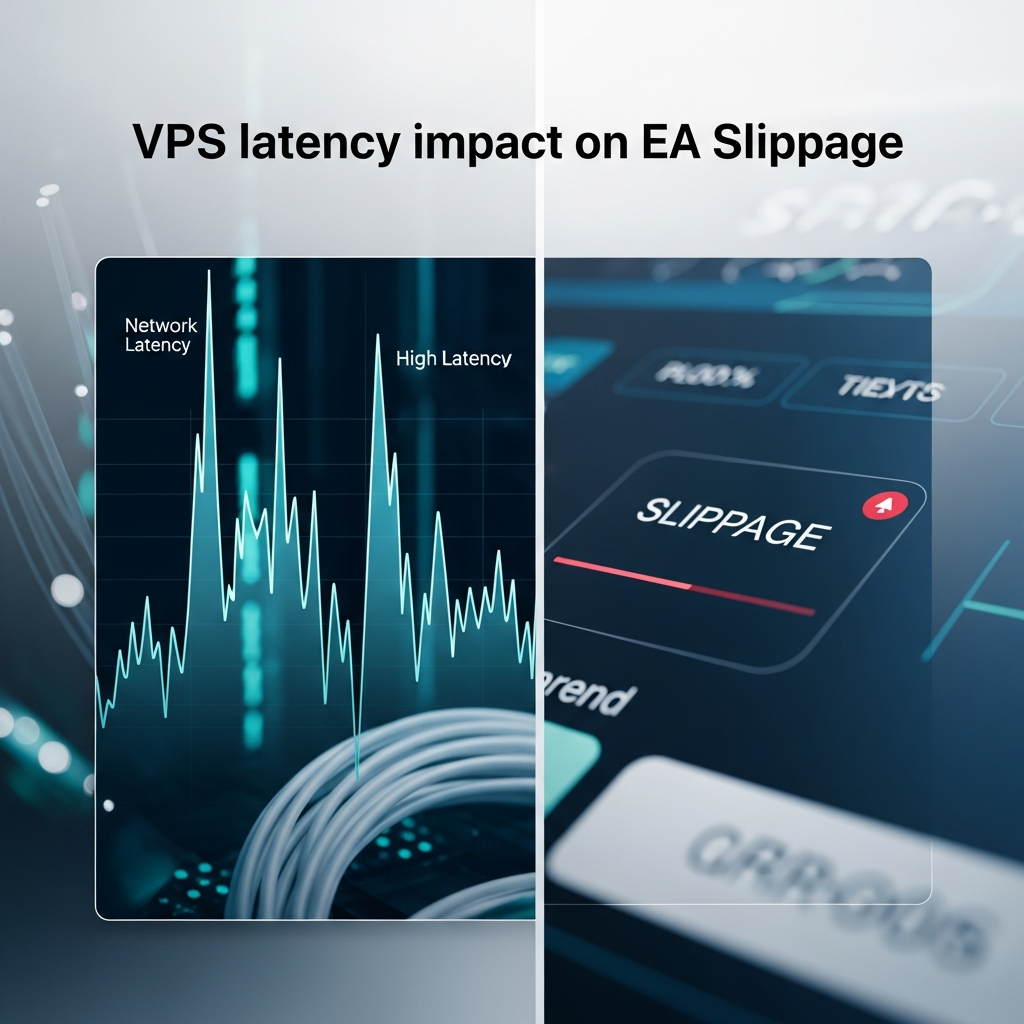
To understand the impact, we must first define our terms with precision. Latency is the time delay between a signal being sent and a response being received. In the context of an EA, this is the time it takes for your trading command to travel from your Virtual Private Server (VPS) to your broker’s server, and for the confirmation to return.
Slippage, on the other hand, is the difference between the price you requested and the price at which the trade was actually executed. While market volatility can cause slippage even with a perfect connection, a significant portion of slippage in automated trading is purely mechanical—caused by the delay (latency) that allows the market price to move before your order reaches the matching engine.
The Anatomy of a Trade in Milliseconds
When your EA identifies a setup, a complex chain of events occurs. Let’s break down the timeline of a typical trade execution in 2026:
- T+0ms: The EA logic triggers a ‘Buy’ signal.
- T+2ms: The trading platform (MT4/MT5/cTrader) packages the order.
- T+20ms: The order travels across the internet from the VPS to the broker’s data center.
- T+25ms: The broker’s gateway receives the order and performs risk checks.
- T+30ms: The order enters the liquidity pool/matching engine.
- T+35ms: The trade is filled, and the confirmation starts its journey back to you.
In this scenario, 35 milliseconds have passed. In a calm market, the price might not move at all during those 35ms. However, during news events, New York/London overlaps, or high-volatility periods, a currency pair can move 0.5 to 2.0 pips in a heartbeat. If the price moves against you during those 35ms, you suffer negative slippage. If you are a scalper aiming for 3-5 pips of profit, losing 1 pip to slippage isn’t just an inconvenience—it’s a 20-33% reduction in your edge.
Why Residential Connections Fail the EA Test
Many novice traders attempt to run EAs from a home computer. A standard residential fiber or 5G connection might seem fast, but it is optimized for throughput (downloading large files) rather than latency (sending small packets instantly). Residential routing is often circuitous, jumping through various ISP nodes before reaching the financial hubs in London (LD4), New York (NY4), or Tokyo (TY3).
A high-quality VPS, conversely, uses ‘cross-connects’ or ultra-low-latency routing. By hosting your EA in the same data center as your broker, you can reduce your ping from 100ms+ down to sub-1ms. This reduction is the most effective way to combat mechanical slippage.
The Multiplier Effect: Latency and Volatility
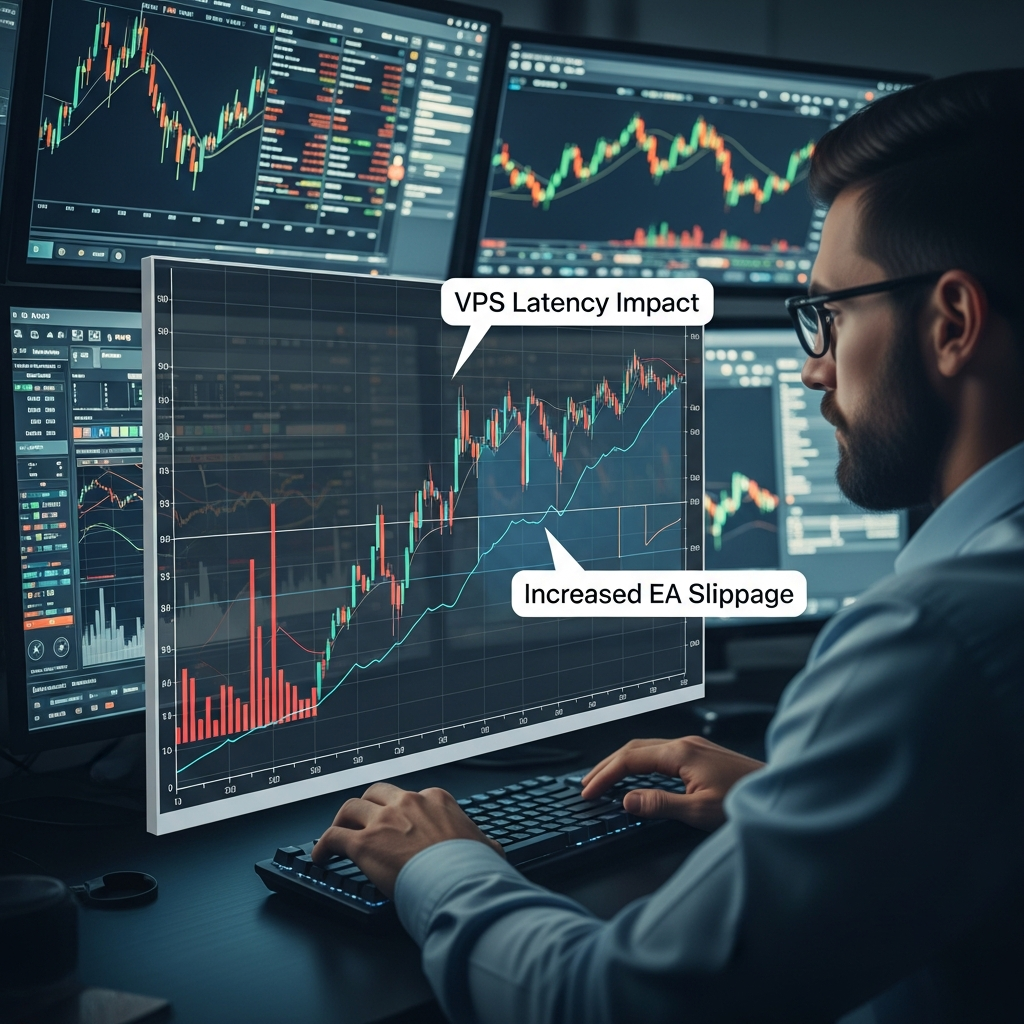
The impact of latency is not linear; it is exponential relative to market volatility. In a ‘flat’ market, a 100ms delay might result in zero slippage. However, during the release of US Non-Farm Payrolls or a central bank interest rate decision, the ‘Price Discovery’ phase happens so rapidly that every millisecond of delay correlates directly with a worse entry price.
The Role of the Broker Bridge
In 2026, the technology used to bridge your MT5 or specialized platform to liquidity providers has evolved. Most top-tier brokers use advanced ‘liquidity aggregators.’ If your VPS has high latency, your order might arrive at the broker just as their best-priced liquidity provider has updated their quote. The aggregator then has to ‘requote’ or move to the next best provider in the ‘Book,’ which inherently has a worse price. This ‘slippage ladder’ is the direct result of your VPS being too far from the action.
Optimizing Your Infrastructure for 2026 Standards
To remain competitive in today’s market, a ‘good enough’ VPS is no longer sufficient. You must look at the specific hardware and network architecture of your provider. Here are the critical factors to consider:
1. Physical Proximity (The ‘Golden Triangle’)
Most major forex and CFD brokers host their execution engines in one of three locations: Equinix LD4 (London), Equinix NY4 (New York), or Equinix TY3 (Tokyo). When choosing a VPS, it is not enough to be in the ‘same city.’ You want a provider that is literally in the same building or has a direct fiber cross-connect to those specific data centers. This can bring your latency down to 0.5ms or less.
2. NVMe Storage and High-Clock CPUs
Latency isn’t just about the network; it’s also about internal processing. An EA that needs to calculate complex indicators across multiple timeframes requires CPU speed. In 2026, VPS providers should offer high-frequency processors (above 3.5GHz) and NVMe storage. If the VPS takes 5ms to process the EA’s logic due to a slow CPU, that is 5ms of extra ‘internal latency’ added to your trade journey.
3. The OS and Resource Allocation
Shared VPS environments are the enemy of consistency. ‘Noisy neighbor’ syndrome occurs when another user on the same physical server spikes their CPU usage, causing your EA to lag. Ensure your provider offers KVM virtualization or dedicated resources, ensuring that your EA has instant access to the processing power it needs exactly when a trade signal fires.
Measuring the Cost of Slippage
To truly understand the impact, traders should perform a ‘Slippage Audit.’ Most modern trading platforms allow you to log the ‘Requested Price’ versus the ‘Executed Price.’ Over a sample of 100 trades, calculate the average pip loss.
For example:
Total Volume: 10 Lots (1,000,000 units)
Avg Slippage: 0.3 pips
Cost of Slippage: $300
If a premium, ultra-low-latency VPS costs $50 a month, but it reduces that average slippage from 0.3 pips to 0.1 pips, it saves the trader $200 in a single month. In this light, a high-quality VPS isn’t an expense; it’s a high-ROI investment in your strategy’s performance.
The Psychological Impact
Beyond the math, latency-induced slippage has a psychological toll. Traders often begin to doubt their strategy or their broker, unaware that the bottleneck is their own infrastructure. Eliminating the latency variable allows you to see the true performance of your EA, enabling better optimization and more confident scaling.
Conclusion: Future-Proofing Your Automated Trading
As we move further into 2026, the gap between institutional-grade infrastructure and retail setups is narrowing, but only for those who pay attention to the details. VPS latency is no longer a niche concern for high-frequency firms; it is a foundational requirement for any retail EA trader who wishes to remain profitable.
By selecting a VPS provider with strategic proximity to exchange hubs, utilizing high-performance hardware, and constantly monitoring slippage logs, you can ensure that your Expert Advisor is competing on an even playing field. Remember: in the world of automated trading, you don’t just trade the market; you trade the network. Speed isn’t just a luxury—it is the very cushion that protects your edge from being eroded by the friction of the digital world.