Mastering the Market: The Essential Deriv Bot Script for Small Accounts
Trading in the financial markets has undergone a massive transformation as we head into 2026. Gone are the days when you needed thousands of dollars to start your journey into automated trading. Today, with platforms like Deriv and its sophisticated DBot interface, anyone with a laptop and a modest balance of $10 to $50 can leverage the power of algorithms. However, the challenge for micro-account holders remains: how do you survive the volatility of indices like V75 or Volatility 100 without blowing your balance in minutes?
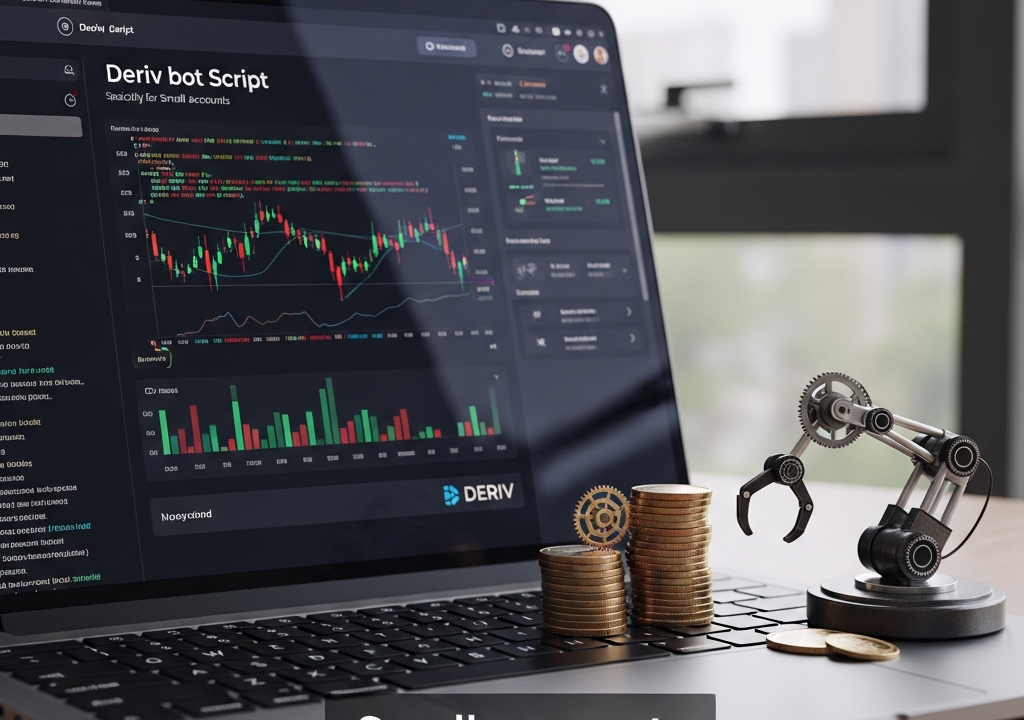
The answer lies in finding—or building—a specialized Deriv bot script for small accounts. Unlike scripts designed for high-net-worth traders, small account scripts prioritize capital preservation over aggressive gains. In this comprehensive guide, we will dive deep into the mechanics of automated trading for small balances, explore the best strategies for 2026, and provide you with the blueprint for sustainable growth.
Why Small Accounts Require a Different Approach
When you are trading with a $20 balance, your margin for error is razor-thin. A standard Martingale strategy—where you double your stake after every loss—is the quickest way to hit a zero balance. If your initial stake is $0.35, a string of just six losses would require a $11.20 stake, consuming over half your capital. One more loss, and you are out of the game.
Effective scripts for small accounts in 2026 focus on “Micro-Compounding.” These scripts utilize high-probability entries, smaller multipliers, and strict stop-loss protocols. The goal isn’t to turn $10 into $1,000 overnight; it is to turn $10 into $12, then $12 into $15, building a cushion that eventually allows for higher stakes.
The Pillars of a Small Account Script
- The Minimum Stake: Always start at the platform minimum, which is currently $0.35. This allows for the longest possible “runway” during losing streaks.
- Loss Limitation: A “Max Consecutive Losses” filter is mandatory. If the script hits three or four losses in a row, it should pause or stop entirely to protect the remaining capital.
- Smart Martingale: Instead of a 2.0x multiplier, small account scripts often use a 1.1x or 1.5x multiplier, or even a “split-recovery” system where the loss is recovered over two or three winning trades rather than one.
Top Strategies for Deriv Bot Scripts in 2026
Not all trading types are created equal when you’re working with limited funds. Here are the three most effective strategies for a Deriv bot script for small accounts today.
1. The Digit Over/Under 2 Strategy
Digit Over/Under remains a favorite because of its high win probability. By setting the prediction to “Over 2,” you have a 70% statistical chance of winning every trade (since the winning digits are 3, 4, 5, 6, 7, 8, and 9). While the payout is lower, the frequency of wins makes it ideal for slow account growth. A script using this strategy should incorporate a delay between trades to avoid “cluster volatility.”
2. The RSI-Based Rise/Fall Script
By 2026, the Deriv Bot (DBot) has integrated more advanced technical indicators. A script that only enters a trade when the Relative Strength Index (RSI) is oversold (below 30) for a “Rise” contract, or overbought (above 70) for a “Fall” contract, significantly increases the accuracy of your entries. For small accounts, waiting for these high-conviction setups is far safer than continuous trading.
3. The Even/Odd “Tick Pattern” Recognition
This strategy analyzes the last five ticks. If the script detects a pattern—for example, three consecutive even numbers—it bets on an “Odd” outcome for the next tick. This mean-reversion approach works exceptionally well on Volatility 10 (1s) Indices, which provide smooth, frequent tick data for the script to analyze.
How to Set Up Your Script: A Step-by-Step Guide
If you have acquired an XML script for your small account, setting it up correctly is vital. Follow these steps to ensure you don’t make a costly configuration error.
Step 1: Import the XML File
Log into your Deriv account and navigate to the DBot platform. Click on the “Import” button and select the .xml file from your device. Once loaded, you will see the block-based logic on your workspace.
Step 2: Define Your Variables
Before hitting the ‘Run’ button, check the “Variables” block. Ensure the following are set:
- Expected Profit (Take Profit): For a $20 account, set this to $1.00 or $2.00 (5-10% daily).
- Maximum Loss (Stop Loss): Set this to $5.00. Never risk more than 25% of a small account in a single session.
- Stake: Ensure this is set to $0.35.
Step 3: Test on a Virtual Account
This is non-negotiable. Even the most reliable 2026 Deriv bot script should be tested on a demo/virtual account for at least 24 hours. Observe how the script handles a losing streak. Does it panic and escalate stakes too quickly? If so, adjust the multiplier before switching to real money.
Advanced Risk Management for Small Balances
Psychology is just as important as the script itself. When you are trading with a small account, the urge to “speed up” the process is intense. However, automated trading is a marathon, not a sprint.
The “Session” Method
Rather than letting a bot run 24/7, divide your day into three 15-minute sessions. Markets on Deriv (Synthetic Indices) are simulated, but they still go through phases of high and low “choppiness.” By running the bot in short bursts, you reduce the likelihood of getting caught in a rare but devastating long-tail losing streak.
Compounding Your Profits
Once your account grows from $20 to $40, do not immediately double your stake. Instead, keep your stake at $0.35 but increase your Take Profit target slightly. Wait until you reach $100 before moving your base stake to $0.50 or $1.00. This conservative approach is how professional algorithmic traders operate.
Common Pitfalls to Avoid in 2026
Many beginners lose their funds not because the script was bad, but because of poor execution. Avoid these common mistakes:
- Over-trading: Running the bot for 5 hours to make $2. The more trades the bot takes, the higher the chance of hitting a statistical anomaly (a long losing streak). Get in, hit your target, and get out.
- Ignoring Market Conditions: While Synthetic Indices aren’t affected by news like the NFP or CPI, they do exhibit different behaviors during high-volume periods. Monitor your bot’s performance and stop it if the market seems too erratic.
- Buying “Holy Grail” Scripts: Be wary of anyone selling a Deriv bot script for small accounts that promises “100% win rates.” No such thing exists. Authentic scripts are tools that manage probability, not magic wands.
The Role of VPS in 2026 Automated Trading
For small account traders, a Virtual Private Server (VPS) might seem like an unnecessary expense, but it can actually save your balance. If your internet connection drops or your laptop goes to sleep while a bot is in the middle of a Martingale sequence, the script may fail to execute the next trade or stop-loss. A VPS ensures your script runs in a stable, 24/7 environment. In 2026, many lightweight VPS options are available for as little as $5 a month, which is a worthy investment once your balance grows past the $50 mark.
Conclusion: Consistency Over Intensity
A Deriv bot script for small accounts is a powerful entry point into the world of algorithmic trading. By focusing on low-stake entries, utilizing Digit Over/Under or RSI strategies, and maintaining a disciplined approach to risk, you can steadily grow a modest balance into a significant portfolio.
Remember, the goal of automated trading in 2026 is to remove human emotion from the equation. Let the script do its job, trust your stop-loss, and focus on the percentage growth rather than the dollar amount. With patience and the right XML configuration, your small account can become the foundation of a successful trading career. Happy trading!