
The Evolution of Automated Trading: Why the Choice Matters in 2026
The financial markets of 2026 are faster, more data-driven, and more accessible than ever before. For the modern retail investor, the question is no longer whether to automate their trading, but rather *how* to do it. The debate between copy trading vs expert advisors 2026 has taken center stage as both technologies have matured significantly, fueled by breakthroughs in artificial intelligence and decentralized finance.
To the uninitiated, both methods might seem identical—after all, they both aim to generate profits without the need for the user to sit in front of a screen all day. However, beneath the surface, they represent two fundamentally different philosophies of wealth management. One is rooted in human intuition and social connectivity, while the other relies on mathematical precision and algorithmic logic.
As we navigate this complex landscape, understanding the nuances of these two paths is essential for anyone looking to preserve and grow their capital in a year characterized by shifting global interest rates and high-frequency volatility.
Understanding Copy Trading in 2026
Copy trading, often referred to as social trading, has undergone a radical transformation. In its early days, it was simply about following a popular trader and hoping for the best. By 2026, copy trading platforms have become sophisticated ecosystems that resemble a hybrid between a social network and a hedge fund.
When you engage in copy trading, you are essentially linking your brokerage account to that of a ‘Master Trader.’ Whenever they execute a trade, the same action is replicated in your account proportionally. This allows beginners to leverage the expertise of veterans, benefiting from their years of experience and market psychological resilience.
The Strengths of Copy Trading
The primary advantage of copy trading in 2026 is the human element. Algorithms, no matter how advanced, often struggle to interpret ‘black swan’ geopolitical events or sudden shifts in market sentiment that aren’t yet reflected in the price data. A human trader can perceive the nuance of a central bank’s tone or a sudden supply chain disruption in a way that a standard EA might not.
Furthermore, copy trading offers unparalleled transparency. In 2026, leading platforms provide deep-dive analytics into a master trader’s history, including their maximum drawdown, average hold time, and even their emotional consistency during volatile periods. This social proofing makes it easier for investors to build trust.
The Drawbacks of Social Dependence
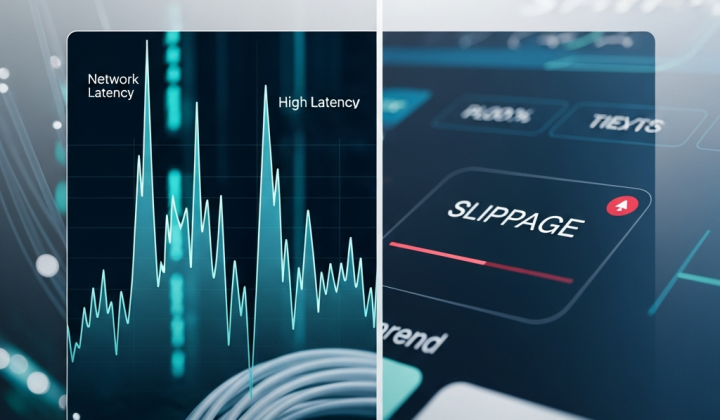
However, copy trading is not without its pitfalls. The biggest risk is slippage. Even in 2026, with ultra-fast fiber-optic connections, there can be a slight delay between the master’s execution and the copy’s execution. In high-frequency environments, these milliseconds can translate into significantly different entry prices, eroding profit margins.
There is also the ‘ego risk.’ Master traders are human; they can have bad days, suffer from ‘revenge trading’ after a loss, or simply change their strategy without warning. When you copy a human, you are also copying their human fallibility.

The Rise of Expert Advisors (EAs) in 2026
On the other side of the ring, we have Expert Advisors, or EAs. These are pieces of software—trading robots—programmed to execute trades based on a specific set of rules. While EAs have been around for decades, the 2026 versions are vastly superior to their predecessors, often incorporating Large Language Models (LLMs) and reinforcement learning to adapt to changing market ‘regimes.’
An EA doesn’t sleep, it doesn’t get tired, and it certainly doesn’t feel fear when a trade goes against it. It is the embodiment of disciplined, rule-based trading.
The Power of Algorithmic Precision
The core benefit of using EAs in 2026 is backtesting and optimization. Before risking a single dollar, a trader can run an EA through decades of historical data to see how it would have performed. This quantitative approach allows for a level of risk management that is simply impossible with copy trading.
EAs are also incredibly efficient at monitoring dozens of currency pairs or assets simultaneously. While a human trader can realistically focus on three or four charts, an EA can scan the entire global market for specific patterns, executing trades the instant criteria are met. This 24/7 presence is vital in 2026, where market moves often happen during ‘off-hours’ in different time zones.
The Technical Barrier to Entry
The downside? EAs require a higher level of technical proficiency. Even though AI-assisted coding has made it easier to create bots, the user still needs to understand the underlying logic. Furthermore, EAs require a stable environment, usually involving a Virtual Private Server (VPS) to ensure they stay online. If the server goes down, the EA can’t manage its open positions, leading to potential catastrophe.
Moreover, EAs are vulnerable to ‘curve-fitting.’ This happens when a bot is tuned so perfectly to past data that it fails to perform when faced with the unpredictable reality of future markets. In 2026, the challenge is finding an EA that is robust enough to handle the ‘unknown unknowns.’
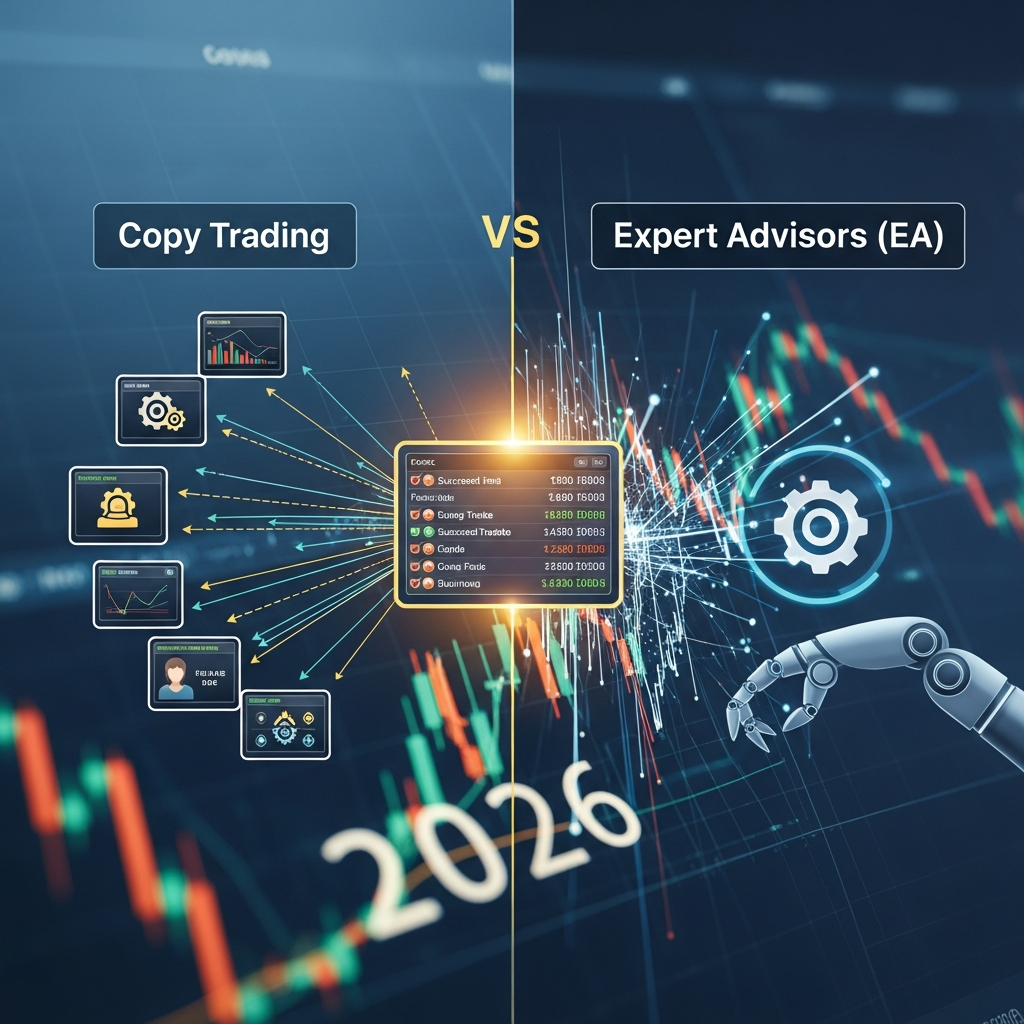
Direct Comparison: Copy Trading vs Expert Advisors 2026
To help you decide which path to take, let’s break down the key differences across four critical categories.
1. Level of Control
In copy trading, you delegate control to another person. While you can usually set a stop-loss for the entire copied portfolio, you have no say in individual trade entries or exits. You are a passenger in their vehicle.
With EAs, you are the mechanic and the driver. You choose the settings, you decide when to turn the bot off, and you can tweak the logic if you see it underperforming. For those with a ‘control freak’ personality, EAs are the clear winner.
2. Cost and Fee Structure
Copy trading typically operates on a profit-sharing basis. In 2026, many master traders charge between 10% and 30% of the profits they generate for you. This is a performance-based fee, meaning you only pay if you make money.
Expert Advisors usually involve an upfront cost or a monthly subscription to the software developer. Additionally, you must account for VPS costs. Over the long term, if you are trading large volumes, an EA is often more cost-effective because it doesn’t take a percentage of your total upside.
3. Emotional Resilience
Copy trading allows you to lean on the emotional strength of an expert. However, seeing another human make a mistake can be more stressful than seeing a bot make one. When an EA loses a trade, it’s just the math not working out for that specific setup. When a master trader loses, you might find yourself questioning their competence, leading to premature ‘un-copying’—often at the worst possible time.
4. Diversification Potential
In 2026, the trend is shifting toward multi-strategy portfolios. Copy trading makes it easy to diversify by following five different traders with five different styles. Achieving the same level of diversification with EAs requires running multiple bots simultaneously, which can be technically taxing and requires significant capital to avoid over-leveraging the account.
The Hybrid Model: The Future of Retail Trading
As we look closer at the 2026 landscape, the most successful traders aren’t choosing one over the other; they are integrating both. This is known as the ‘Quant-Social’ approach.
An investor might allocate 50% of their capital to a high-performing EA that focuses on mean reversion in the Forex markets (the ‘stabilizer’), while allocating the other 50% to copy three different human traders who specialize in volatile crypto-assets or emerging market stocks (the ‘alpha seekers’).
This hybrid approach mitigates the risks inherent in both systems. If the EA hits a period of stagnation because the market is too trending, the human traders—who thrive on trends—can pick up the slack. Conversely, if the human traders are paralyzed by political uncertainty, the EA will continue to execute its cold, hard logic without hesitation.
Critical Risk Management for 2026
Regardless of whether you choose copy trading vs expert advisors 2026, risk management remains the only ‘holy grail’ in trading. The 2026 market is characterized by liquidity ‘flash events.’ To survive, your strategy must include:
- Hard Stop-Losses: Never rely on a master trader to ‘manually’ close a losing trade. Always have an account-level equity protection setting.
- Dynamic Position Sizing: Ensure your EA or copy-settings adjust the lot size based on your current balance, not a fixed amount.
- Regular Audits: Markets change. An EA that worked in 2026 might be obsolete by mid-2026. A trader who was a hero last year might have lost their ‘edge’ this year.
Conclusion: Which One Should You Choose?
The choice between copy trading vs expert advisors 2026 ultimately depends on your most valuable resource: time.
If you are a professional with a demanding career who wants exposure to the markets without a steep learning curve, copy trading is your best entry point. It allows you to participate in the global economy by ‘hiring’ the best minds to work for you.
If you have a technical inclination, enjoy data analysis, and want to build a scalable trading business that isn’t dependent on the whims of another person, Expert Advisors are the way to go. The initial setup is harder, but the level of autonomy and scalability is unmatched.
As we move through 2026, the line between these two continues to blur. Many master traders are now using EAs to manage their own trades, which you then copy. We are entering an era of ‘cyborg trading,’ where the best results come from the perfect marriage of human oversight and machine execution. Whichever path you choose, stay disciplined, stay informed, and never invest more than you can afford to lose.