Introduction to High-Frequency Automation on Deriv
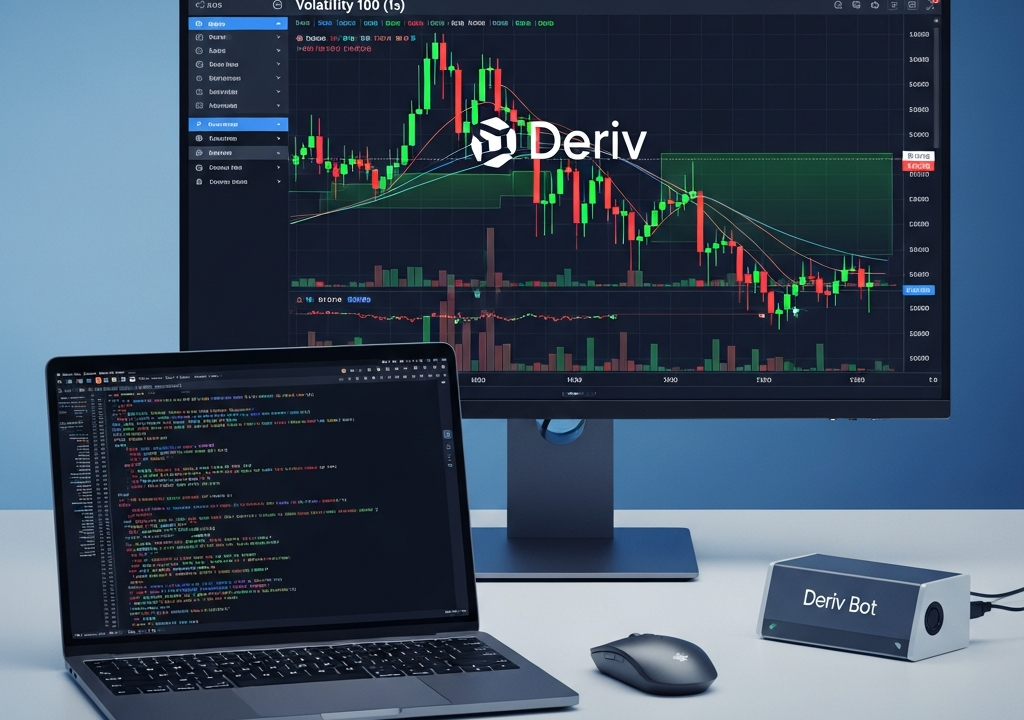
As we navigate the trading landscape of 2026, the demand for precision and speed has never been higher. For retail traders, the ability to capitalize on market movements that occur within seconds is no longer a luxury—it is a necessity. Among the most popular assets for high-frequency trading is the Volatility 100 (1s) Index, a synthetic index available on the Deriv platform. To trade this effectively, many are turning to the Deriv Bot Volatility 100 1s strategy.
The Volatility 100 (1s) index is unique because it generates a price tick every single second, 24 hours a day, 365 days a year. Unlike traditional forex markets that are influenced by global news, interest rates, or geopolitical tensions, synthetic indices are governed by algorithms that simulate real-world market volatility. This makes them perfectly suited for automated trading via DBot (Deriv Bot), where technical analysis and mathematical probability take center stage.
Understanding the Volatility 100 (1s) Index
Before diving into the mechanics of the bot, it is crucial to understand what makes the Volatility 100 (1s) index tick—literally. The “1s” suffix indicates that the index updates every second. This constant stream of data provides a massive sample size for trading bots to analyze. The “100” refers to the volatility level, indicating a high-intensity market where price swings are frequent and significant.
In 2026, the liquidity and smoothness of these synthetic indices have reached a point where slippage is minimal, making them the primary choice for scalpers and algorithmic traders. Because the market is open even on weekends, your Deriv Bot Volatility 100 1s strategy can run continuously, provided you have the right risk parameters in place.
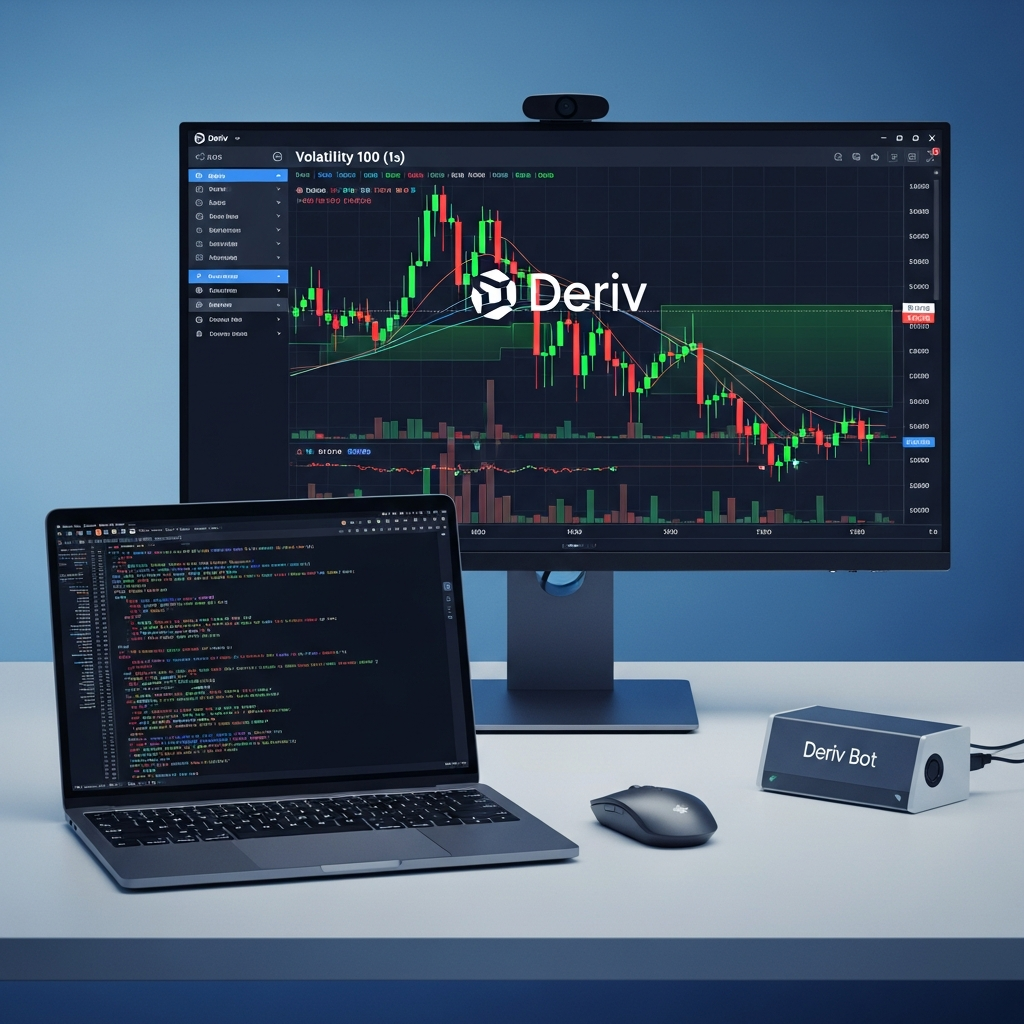
The Architecture of a Successful DBot Strategy
Building a bot on Deriv’s DBot platform involves using visual “blocks.” While it may look simple, the logic behind a profitable strategy requires a deep understanding of market mechanics. A successful strategy for the 1s index usually rests on three pillars: Entry Logic, Exit Logic (or Contract Duration), and Money Management.
1. The Entry Logic: Indicators and Signal Processing
For the Volatility 100 (1s) index, relying on a single indicator is often a recipe for disaster. Because the timeframe is so compressed, “noise” is prevalent. In 2026, the most effective bots use a combination of:
- Relative Strength Index (RSI): Set to a short period (e.g., 5 or 7 periods) to identify extreme overbought or oversold conditions within seconds.
- Exponential Moving Averages (EMA): Using a fast EMA (9) and a slow EMA (21) to determine the immediate trend direction.
- Bollinger Bands: To measure the current “width” of the market volatility and predict mean reversion.
2. Contract Type and Duration
With the 1s index, you aren’t looking for long-term trends. Most successful Deriv Bot Volatility 100 1s strategies utilize “Rise/Fall” or “Over/Under” contract types with durations ranging from 1 to 5 ticks. In 2026, the “Over/Under” strategy has gained popularity because it allows traders to bet on the digit outcome of the tick, which can be statistically modeled more accurately than pure price movement in such short bursts.
Step-by-Step: Setting Up the Mean Reversion Strategy
Let’s look at a concrete example of a Mean Reversion strategy designed specifically for the Volatility 100 (1s) index. This strategy assumes that if the price moves too far from its average in a single second, it is likely to snap back.
Step 1: Define the Variable Blocks
In your DBot dashboard, you must first define your variables. These include your Stake, Take Profit, Stop Loss, and your RSI threshold. For V100 (1s), an RSI threshold of 80 for overbought and 20 for oversold is common.
Step 2: Logic for Purchase
You will set the bot to monitor the RSI on every tick. The logic block should read: “If RSI (5) is greater than 80, Purchase Fall; If RSI (5) is less than 20, Purchase Rise.” This takes advantage of the quick pulses in the Volatility 100 (1s) index.
Step 3: The Martingale Variable (Use with Caution)
Many traders in 2026 still use Martingale (doubling the stake after a loss) to recover quickly. However, given the speed of the 1s index, a streak of losses can occur in seconds. A smarter approach is a “Limited Martingale” or a “D’Alembert” system, where the stake increases linearly rather than exponentially.

Advanced 2026 Optimization: AI and Cloud Integration
As we move through 2026, the most advanced Deriv Bot Volatility 100 1s strategies are no longer just static blocks. Traders are now utilizing external APIs to feed AI-driven signals into their DBot. By using a Python-based script on a VPS (Virtual Private Server), traders can analyze the last 1,000 ticks of the Volatility 100 (1s) index to find patterns that the human eye—and basic blocks—might miss.
Cloud hosting is essential. If your internet connection lags for even two seconds, your bot might miss the entry or exit point on a 1s index. Modern traders ensure their DBot is running on a low-latency server located close to Deriv’s data centers to ensure execution speeds under 50ms.
Risk Management: The “Holy Grail” of Bot Trading
No Deriv Bot Volatility 100 1s strategy is complete without a robust risk management framework. The speed of the 1s index is a double-edged sword; it can grow an account by 20% in an hour, but it can also wipe it out just as fast.
The 1% Rule
Never allow your bot to stake more than 1% of your total balance on a single trade. In the high-frequency world of the 100 (1s) index, you are playing a volume game. You want to win 55-60% of your trades over hundreds of executions, not bet it all on one tick.
The Daily Circuit Breaker
In 2026, smart bots include a “circuit breaker” block. This is a logic gate that stops the bot entirely if it hits a specific loss threshold (Stop Loss) or a profit target (Take Profit). This prevents the bot from trading during “black swan” algorithmic glitches or from giving back profits due to over-trading.
Common Pitfalls to Avoid
Even with a sophisticated Deriv Bot Volatility 100 1s strategy, many traders fail due to preventable mistakes:
- Over-optimization: Fitting your bot too closely to historical data (curve fitting). What worked yesterday on the V100 1s index might not work today if the algorithm’s underlying volatility parameters shift slightly.
- Ignoring Market “Mood”: While synthetic, these indices do have phases of trending vs. ranging. A bot designed for mean reversion will fail miserably during a strong, one-sided trend.
- Neglecting Backtesting: Deriv provides a demo account for a reason. In 2026, you should run your bot for at least 24 hours on demo to observe how it handles different cycles before going live.
The Future of Synthetic Index Trading
The evolution of the Deriv Bot Volatility 100 1s strategy reflects the broader trend in financial markets: the democratization of algorithmic trading. Tools that were once reserved for institutional hedge funds are now available to anyone with a Deriv account and the patience to learn the logic of DBot.
As we look further into 2026 and beyond, we can expect even more complex synthetic indices and more powerful automation tools. Staying ahead requires a commitment to constant testing, refining, and, most importantly, the discipline to follow the strategy even when the market gets volatile.
Conclusion
Mastering the Volatility 100 (1s) index through automation offers a path to consistent results, provided you treat it as a business rather than a gamble. By combining the speed of the DBot with a sound technical strategy and rigorous risk management, you can navigate the 1-second ticks with confidence. Remember, the best strategy isn’t the one that makes the most money in five minutes—it’s the one that survives the market for five months.
Start small, test your blocks, and let the Deriv Bot Volatility 100 1s strategy work for you in the high-speed world of 2026 trading.