Introduction: The Evolution of Automated Trading in 2026
As we navigate the financial landscapes of 2026, the barrier between professional quant traders and retail investors has virtually vanished. At the heart of this revolution is Deriv Bot (formerly known as DBot), a sophisticated yet accessible platform that allows anyone to build automated trading scripts using visual blocks. However, a bot is only as intelligent as the logic it follows. To succeed, you must understand and implement the best indicators for Deriv Bot to filter out market noise and capture high-probability setups.
Whether you are trading synthetic indices like Volatility 75 (1s) or traditional Forex pairs, your success depends on a blend of trend, momentum, and volatility analysis. In this comprehensive guide, we will dissect the top-tier indicators currently dominating the algorithmic space and show you how to stack them for maximum efficiency.
Why Choosing the Right Indicators Matters
In the world of automated trading, “garbage in, garbage out” is the golden rule. If your Deriv Bot relies on lagging or mismatched indicators, it will execute trades based on outdated information, leading to a depleted balance. By 2026, market algorithms have become faster, requiring traders to use indicators that can provide both early signals and robust confirmation.
The right indicators help your bot answer three critical questions:
- Direction: Is the market trending up, down, or sideways?
- Momentum: Is the current move strong enough to continue, or is it losing steam?
- Volatility: Is there enough price movement to reach a profit target, or is the market too stagnant?
1. The Relative Strength Index (RSI): The King of Momentum
The RSI remains one of the best indicators for Deriv Bot because of its versatility. It measures the speed and change of price movements on a scale of 0 to 100. In 2026, sophisticated bots no longer just look for the classic 70/30 overbought and oversold levels.
Modern RSI Strategies for DBot
Instead of simple reversals, high-performing bots now use the 50-level crossover. When the RSI crosses above 50, it signifies bullish momentum; below 50, bearish. By programming your Deriv Bot to only take ‘Rise’ trades when the RSI is above 60, you ensure you are trading with the current strength of the market.
2. Exponential Moving Averages (EMA): The Trend Foundation
While Simple Moving Averages (SMA) are useful, the Exponential Moving Average (EMA) is superior for bot trading because it places more weight on recent price data. This reduces lag, which is vital when trading fast-paced synthetic indices.
The EMA Cross Strategy
A staple in any professional toolkit is the 9-period and 21-period EMA crossover. When the 9-EMA crosses above the 21-EMA, your bot receives a ‘Buy’ trigger. In 2026, many traders also add a 200-period EMA as a “Global Filter.” The bot is only allowed to buy if the price is above the 200-EMA, ensuring it never trades against the primary long-term trend.
3. Bollinger Bands: Capturing Volatility Brackets
Volatility is the lifeblood of Deriv’s synthetic indices. Bollinger Bands consist of a middle SMA and two outer bands calculated via standard deviation. They are exceptional for identifying when a market is “overstretched.”
For a Deriv Bot, Bollinger Bands can be used to execute ‘Mean Reversion’ strategies. When the price touches the upper band and the RSI is overbought, the bot triggers a ‘Fall’ trade, betting that the price will return to the middle moving average. Conversely, in a strong trending market, a “Walking the Bands” strategy can be used where the bot stays in a trade as long as the price hugs the outer limits.
4. MACD (Moving Average Convergence Divergence)
The MACD is a trend-following momentum indicator that shows the relationship between two moving averages of a security’s price. For Deriv Bot users, the MACD histogram is the most valuable component. It provides a visual representation of whether momentum is increasing or decreasing.
In 2026, advanced bot configurations use the MACD to avoid “fakeouts.” By requiring the MACD histogram to be increasing in size before entering a trade, the bot avoids entering late into a trend that is about to reverse.
5. Stochastic Oscillator: Precision Timing
If the RSI is the king of momentum, the Stochastic Oscillator is the queen of timing. It compares a specific closing price of a security to a range of its prices over a certain period. This is particularly effective for “Touch/No Touch” or “Digit” contracts on Deriv.
By integrating a Stochastic filter (K% and D% lines) into your blocks, you can ensure that your bot only enters a trade when the market is perfectly primed for a pivot, reducing the drawdown significantly.
Combining Indicators: The “Power Trio” Logic
Using a single indicator is a recipe for disaster. The most successful Deriv Bots in 2026 utilize a “Triple Confirmation” logic. Here is a sample logic block structure you can build:
- Condition 1 (Trend): Price must be above the 50-period EMA.
- Condition 2 (Momentum): RSI must be between 55 and 70 (not yet overbought).
- Condition 3 (Volatility): The latest candle must have closed outside the 20-period Bollinger Middle Band.
Only when all three blocks return ‘True’ does the bot execute the trade. This multi-layered approach is why these are considered the best indicators for Deriv Bot.
Optimizing for Synthetic Indices (V75, V100, Jump)
Synthetic indices are unique because they are not affected by real-world news events like NFP or interest rate hikes. This makes them purely technical. When setting up your indicators for these markets, remember that they tend to trend much longer and harder than Forex pairs.
For Volatility 75 (V75), increasing the period of your RSI to 21 (instead of the standard 14) can help filter out the “whipsaw” movements common in these high-volatility environments. In 2026, the most profitable bots on the platform are those that have been tuned specifically for the rhythm of the specific index they are trading.
Risk Management: The Hidden Indicator
While not a technical indicator found in a chart gallery, your risk management logic is the most important “indicator” for your bot’s survival. In 2026, savvy traders move away from simple Martingale (doubling down on losses) and toward “D’Alembert” or “Position Sizing based on ATR (Average True Range).”
By using the ATR indicator, your Deriv Bot can calculate the current market volatility and adjust its stake size automatically. If the ATR is high (high risk), the bot lowers the stake. If the ATR is low (stable market), it increases the stake. This is the hallmark of a professional-grade trading algorithm.
Backtesting Your Indicators in 2026
Before running your bot on a real account, you must utilize the backtesting tools available on Deriv. A strategy might look good on paper, but historical data might reveal that it fails during specific market cycles. Look for a “Profit Factor” of at least 1.5 and a maximum drawdown of less than 20% of your virtual balance before going live.
Common Pitfalls to Avoid
Even with the best indicators for Deriv Bot, many traders fail due to these common mistakes:
- Over-optimizing: Changing settings every hour. Markets need time to play out.
- Indicator Redundancy: Using three different momentum indicators (like RSI, Stochastic, and Williams %R) that all tell you the same thing. Mix different categories (Trend + Momentum + Volatility).
- Ignoring the Timeframe: An indicator on a 1-minute chart is far less reliable than one on a 15-minute or 1-hour chart.
Conclusion: The Path to Automated Profitability
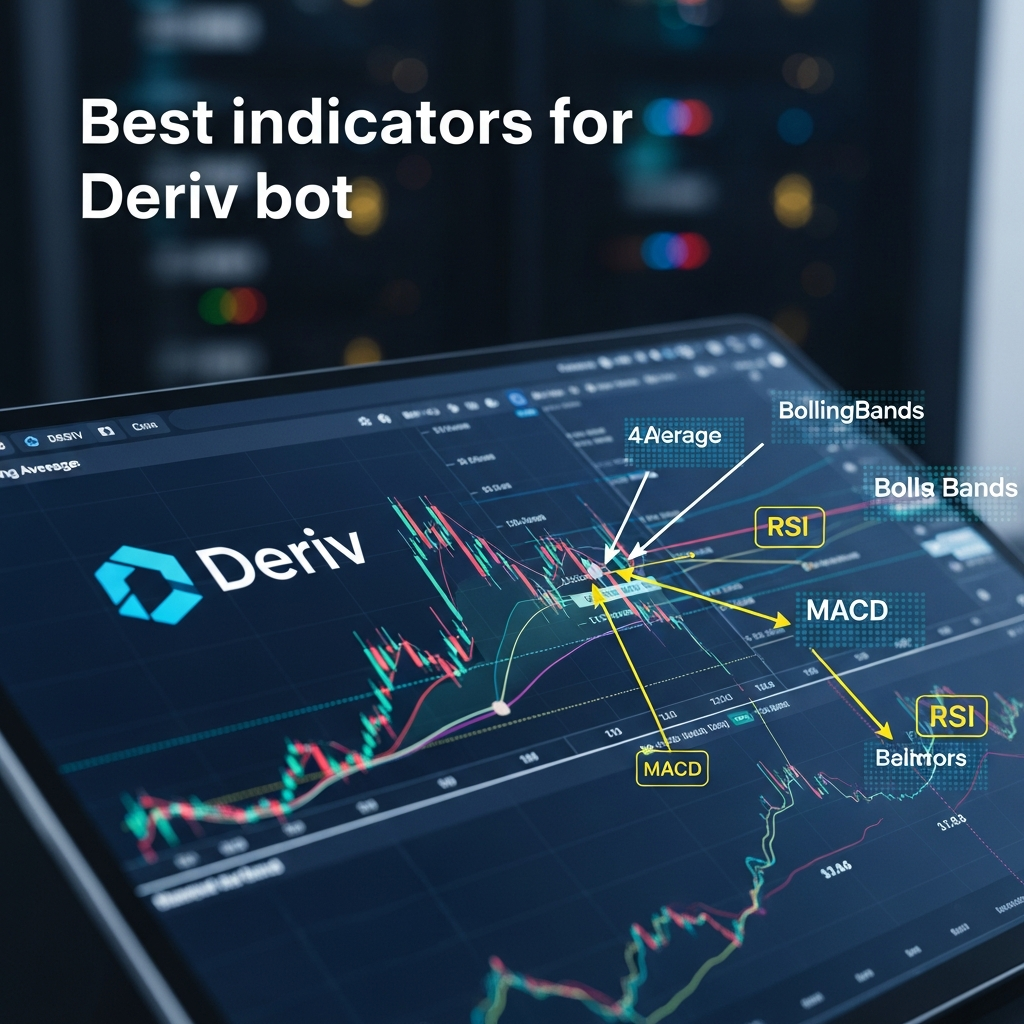
The quest for the best indicators for Deriv Bot is not about finding a magic wand; it is about building a robust, logical framework that can withstand market fluctuations. In 2026, the integration of RSI, EMA, Bollinger Bands, and MACD remains the gold standard for those looking to automate their wealth generation.
Start by mastering one indicator at a time. Build a simple bot, observe its behavior on a demo account, and slowly layer in confirmations. With patience and the right technical tools, your Deriv Bot can become a powerful asset in your financial portfolio. The future of trading is automated—make sure your bot is equipped with the best tools available.